The preschool and pre-k homeschool curriculum that grows with your child
A printed, PDF or boxed curriculum gives every child the same plan on the same day. Kindy builds the plan around yours. Every skill your child needs before kindergarten, in the order children really learn them. It knows where your child is, tells you what to work on today, and moves forward when your child does.
Free for 7 days, then $9.99 a month. It starts with a short check of what your child can already do. Cancel in one tap.
You are giving these years everything. Your curriculum should keep up.
You did not choose to homeschool preschool to do less. You chose it to give your child the most: your attention, your time, a start built around who they are.
A printed or PDF curriculum cannot know your child. So it hands every family the same days in the same order, and leaves you to track, skip, repeat and judge on your own. That is where the planners, the spreadsheets and the late-night second-guessing come from. Not from you doing too little. From your tools doing too little.
Kindy is a curriculum that knows your child. It holds the whole map of preschool skills, knows where your child stands on each one, and tells you what to work on today and why. When your child moves, the plan moves. When you bring your own ideas and materials, they count. You keep the teaching. Kindy carries the structure.
Built by curriculum specialists, in the right order

Vida Mercer
Lead curriculum designer · early childhood consultant since 2005
Kindy's curriculum is written and sequenced by early childhood specialists, led by Vida Mercer, working from research on how three, four and five year olds develop. Every one of the 218 skills is mapped to the CDC's developmental milestones and placed in the order children really learn it, so nothing important is skipped and nothing is asked before your child is ready. Each skill comes with several hands-on activities, and the same skill comes back in different ways until it sticks. That is how children this age learn best: one good thing, many times, with you. Read more about us
What the curriculum covers
Kindergarten teachers are not looking for a child who can read. They hope for one who can say goodbye at the door, hold a pencil, wait for a turn and tell you what happened at recess. Kindy covers all of it. Here is each area, where many kids are around age 3, and where they are heading by the first day of kindergarten.
Every child moves at their own pace. These are directions of travel, not deadlines.
Letters and early reading
67 skills · 145 activitiesAround 3: knows a few letters, often the ones in their own name, and asks for the same book every night.
By kindergarten: knows most letters, big and small, and many of their sounds. Writes their first name. Knows we read from left to right.
In Kindy: one letter at a time, with its sound, in games like turning S into a snake or hunting for S on a cereal box.
Numbers and early math
55 skills · 80 activitiesAround 3: counts a few things out loud, sometimes skipping one. Knows "more" and "less."
By kindergarten: counts out loud to 20 and beyond, counts a group of objects one by one and knows the last number says how many, knows the numbers 1 to 10 by sight, names basic shapes, spots and continues a simple pattern.
In Kindy: rolling dice and building towers, counting scoops and cups while you cook together, number hunts at the store.
Feelings and friends
44 skills · 90 activitiesAround 3: big feelings, fast. Plays next to other kids more than with them. Taking turns is hard.
By kindergarten: names their feelings, uses a calm-down trick with a little help, takes turns, shares, and can say goodbye at drop-off.
In Kindy: singing and acting out feelings, a feelings word of the day, belly breathing practiced while things are calm.
Thinking and problem solving
22 skills · 64 activitiesAround 3: sorts by color, does simple puzzles, asks "why?" about everything.
By kindergarten: remembers details from a story, puts things in order, notices what caused what, tries a second way when the first one does not work.
In Kindy: story memory games, "what happens next?", wondering out loud together.
Talking and listening
17 skills · 62 activitiesAround 3: talks in short sentences that people outside the family mostly understand.
By kindergarten: tells a story with a beginning, a middle and an end. Follows directions with two or three steps. Asks and answers questions. Is understood by strangers.
In Kindy: storytime games, "tell me about your game," retelling a favorite book in their own words.
Little hands (fine motor)
11 skills · 72 activitiesAround 3: grips a crayon with the whole hand, snips with scissors, stacks a tower of blocks.
By kindergarten: holds a pencil with thumb and fingers, cuts along a line, draws a person with a head, arms and legs, works buttons and zippers, opens a lunchbox.
In Kindy: tearing paper for a collage, clothespins, tweezers and pom-poms, the small play that builds a strong pencil grip.
Focus and self-control
woven through every areaAround 3: stays with one thing for a few minutes, then moves on.
By kindergarten: sits for a short story, follows a routine, waits a moment instead of grabbing.
In Kindy: it grows inside every activity, because each one asks for a few minutes of calm attention with you.
Structured enough to cover everything. Gentle enough to follow your child.
Kindy covers every developmental area, in order, so nothing gets missed. And almost none of it happens at a desk. Skills are taught through play, through talk, and through the day you already have: the walk, the grocery store, the library, bathtime.
If your child is not into today's activity, open the alternatives that teach the same skill and pick one that fits their mood. Or move to a different skill for now. The first one comes back another day, when your child is more ready for it. The goals stay fixed. The way there follows your child.
Teaching your child to read is no harder than teaching them to zip a coat.
You already teach your child every day: how to hold a spoon, put on shoes, say sorry. You did not need a degree for that. You needed to know what comes next and how to show it.
That is exactly what Kindy gives you for letters, numbers, feelings and everything else kindergarten asks for: the right skill at the right time, an activity that teaches it, and the reason it matters, so you are never doing things blind.
You know your child better than any teacher ever will. You have the bond and the trust, and you have the moments a classroom never gets. With the order and the intention handled for you, those moments become the best possible preschool there is: yours.
The home base of your homeschool
Everything you do with your child lives in one place, in your pocket.
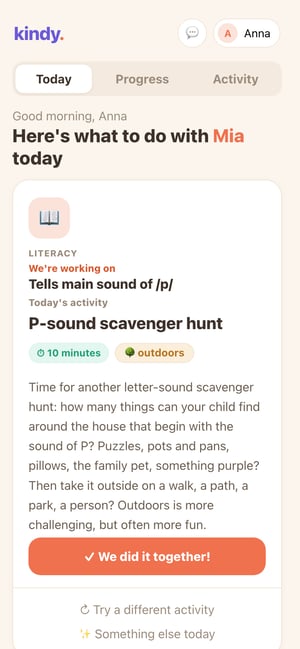
Today's focus, with the why
One skill and one activity chosen for your child, and the reason it matters right now. You never do an activity blind.
The whole skill map
All 218 skills across 7 areas, in order, with where your child stands on each. You can see the whole road, not just today.
Pick the skill, or let Kindy
Take the skill Kindy suggests, ask for a different one, or choose one yourself. The plan is yours to steer.
Alternatives for every skill
Not in the mood for the suggested activity? Browse the others that teach the same skill and pick the one that fits your child today.
Your own activities count
Log the Montessori tray, the library book, the co-op morning. Tie it to the skill it teaches and it credits that skill, exactly like a Kindy activity. Your child moves along the same curriculum.
An activity tracker for everything
Every activity you do, in the app or outside it, in one place. Add the museum day and the puzzle at Grandma's. The whole picture of what you two are doing.
Progress by skill, area and date
One tap after each activity keeps it current. See each area fill in, skill by skill, paced to your child's kindergarten start date.
Controls for your homeschool
Pause a skill set for now and its activities leave the rotation until you bring it back. Kindy plans around your choices.
One day, your way
Kindy opens with one skill and one activity chosen for your child. From there, the day is yours.
Kindy suggests a skill and an activity
Chosen from where your child is right now, with the why.
Keep it, or steer
Not the right skill for today? Ask for another, or choose one yourself. Not the right activity? Pick an alternative that teaches the same skill, or log your own.
Do it together, then tap how it went
Nailed it, Almost, or Not yet. That tap keeps the plan true to your child.
One more? Up to five a day
Across different areas, as your morning allows. One still counts on a busy day.
A full homeschool morning can hold five skills in five areas
Five real Kindy activities for a 4-year-old. Yours will differ, because every one is picked for your child.
Turn S into a snake
Draw a big S and a small s. S looks like a snake and even hisses like one, so add googly eyes and decorate both letters into proper snakes.
You need: paper and crayons, or the printableBuild a dice-roll tower
Roll the die and count the dots together. Stack that many blocks, counting each one as it goes on. Knock it all down and roll again.
You need: a die and some blocksSing and act out feelings
Sing "If You're Happy and You Know It," then change the feeling each verse. Surprised? Say "Oh my!" Scared? Shiver and shake.
You need: nothingClothespin clip-on
Clip clothespins around the rim of a cup. Pinching them open builds the same small muscles your child will use to hold a pencil.
You need: clothespins and a cupStory memory challenge
Read a story together, then make a game of remembering as many details as you can. For a bigger challenge, your child retells it in their own words.
You need: a favorite bookThree "Nailed it"s and a skill is mastered. It steps out of the daily plan and returns now and then for a quick review, so it sticks.
Preschool or pre-k? Your child starts where they actually are.
People use the words in different ways. Most often, preschool means the year a child is around 3, and pre-k means the year before kindergarten, around 4. At home, they are one stretch of time: the two years or so when your child grows from "knows a few letters" into "ready for the classroom."
That is why Kindy is one curriculum, not two. Your child does not start at "the 3-year-old level" or "the pre-k level." A short check of what they can already do places them on every skill. A 3-year-old who knows every letter gets letter sounds. A 4-year-old still working on scissors gets more scissors. Birthdays do not decide. Your child does.
Kindy works out your child's kindergarten start from their birthday and paces the plan to that first day, so the skills that matter most get the most time.
A traditional curriculum, or a living one
Whether it comes as a PDF, a book or a box in the mail, a traditional curriculum is a fixed plan on paper. Here is what changes when the plan can know your child.
| A traditional curriculum (PDF, book or box) | Kindy |
|---|---|
| The same order for every child | Your child's order, from what they can already do |
| The same number of days for every child | Paced to your child's kindergarten start date |
| One path, from one author | Kindy's activities, alternatives for every skill, and your own materials, all counting toward the same skills |
| You track, skip, repeat and judge | Kindy tracks, reviews and moves forward when your child is ready |
| Done when the book ends | Done when your child is ready for kindergarten |
Want it side by side with a specific program? See how Kindy compares to 14 popular preschool options.
Choosing a preschool homeschool curriculum: 5 questions to ask
Secular or faith-based?
Many popular preschool curricula are faith-based. Kindy is secular. It fits any family, and faith can be part of your day however you like. More on Kindy as a secular curriculum.
Does it follow your child, or a fixed order?
A fixed order is simple to print. A plan that adapts means no time spent on what your child already knows, and more time on what they are ready for next.
Can you bring your own materials and ideas?
Your library books, your Montessori shelf, your co-op. In Kindy they count toward the same skills as its own activities.
Screens or no screens?
Some programs are apps for the child. Kindy is an app for you. Your child plays, talks, cuts and counts with you, off screen.
What does it cost for the whole two years?
Add up the price and the supplies. Kindy is $9.99 a month and uses what you already have at home.
Price
7 days free, then $9.99 a month.
Each additional child: $4.99 a month, with their own plan.
We email you before your card is charged. Cancel anytime in the app.
Questions homeschool moms ask us
Is this a complete preschool homeschool curriculum?
Yes. Kindy covers 218 skills across 7 developmental areas: letters and early reading, numbers and early math, talking and listening, thinking, feelings and friends, fine motor, and focus. Every skill is sequenced by early childhood specialists and mapped to the CDC's developmental milestones. It is the whole two years before kindergarten, in one place.
How is Kindy different from a printed or PDF curriculum?
A printed, PDF or boxed curriculum gives every child the same plan on the same day, and leaves you to track, skip and repeat on your own. Kindy starts from what your child can already do, tells you what to work on today, and moves forward when your child does. Your own materials plug in and count toward the same skills.
Can I use my own materials and activities?
Yes. Choose a skill, or take the one Kindy suggests, then use a Kindy activity, browse the alternatives for that skill, or log your own. A logged activity credits the same skill as a Kindy activity, so your child moves along the same curriculum. The activity tracker also keeps everything you do outside the app.
How much can we do in a day?
As much as fits your homeschool. Kindy suggests one activity to start and offers more, up to five a day, across different areas. Most activities take about ten minutes. On a full morning, do several. On a busy day, one still counts.
What age should we start?
Most families start around 3, but you can start any time before kindergarten. Kindy begins where your child is, not where their age says, and paces the plan to their first day of school.
Do I need teaching experience?
No. Every activity tells you what to grab, what to do and what to say, and why it matters. You already teach your child every day. Kindy gives you the order and the intention.
Is Kindy secular?
Yes. Kindy is a secular preschool curriculum. It fits families of any faith or none, and faith can be part of your day however you like.
Is my child on a screen?
No. Kindy is an app for you, on your phone. Your child plays, talks, cuts and counts with you, off screen.
What materials do I need?
Mostly things you already have: paper, crayons, blocks, snacks, books. 158 activities come with an optional printable, and a few include a short video for you.
Can I use it with more than one child?
Yes. Each child gets their own plan based on what they can do, for $4.99 a month per additional child.
What if my child is already ahead in some areas?
Then Kindy skips what they know. Skills your child has mastered leave the daily plan and only return for quick reviews, so the time goes where it is needed.
What happens if we take a break?
Nothing breaks. Kindy picks up where your child is whenever you come back. There is no "behind."
How does the free week work?
Start with the short check of what your child can already do, then begin your free week. You get the full curriculum for 7 days. We email you before your card is charged, and you can cancel anytime in the app.
More for your situation
The same curriculum, explained for where you are starting from.
Two years from now
Your child walks into kindergarten with every one of those 218 skills behind them: the letters, the counting, the pencil grip, the goodbye at the door. And they learned it all at home, with you.
Free for 7 days, then $9.99 a month. It starts with a short check of what your child can already do.