Looking for engaging ways to teach your preschooler the letter Q?
You're in the right place!
This collection of hands-on letter Q activities combines crafts, games, and sensory play to help your child recognize, write, and remember the letter Q.
These activities are perfect for homeschool preschool families who want to make learning the alphabet fun and memorable. Each activity uses simple materials you already have at home and takes just minutes to set up. Whether your child is just starting to learn letters or needs more practice with letter recognition, these playful activities will keep them engaged while building essential pre-literacy skills.
10 Letter Q Activities Your Preschooler Will Love
Activity 1: Queen Letter Collage
⏱️ Prep Time: 5 minutes
🎨 Materials: Construction paper (various colors), scissors, glue stick, letter Q outline, googly eyes (optional)
This letter Q craft is a must-try activity for preschoolers! Since queen starts with the letter Q, making a queen collage is the perfect way to create a memorable letter craft. Kids love adding a sparkly crown and fancy dress and watching their queen come to life, and this activity naturally reinforces the connection between the letter Q and its sound.
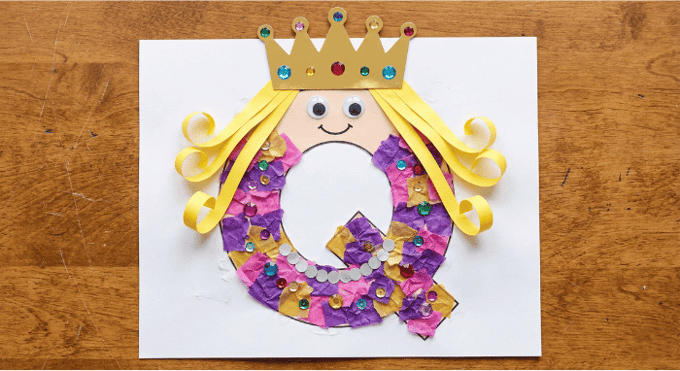
How to do it:
- Print, draw, or glue a letter Q on white cardstock.
- The top part of the Q becomes the queen's head, and the rest becomes part of her colorful dress.
- Draw a simple face in the upper part (or add googly eyes and draw a smile).
- Cut long strips of yellow or brown paper for hair and glue them on the sides of the circle.
- Cut out a crown shape from gold or yellow construction paper and glue it at the top of the circular Q, covering the beginning of the yellow hair strips.
- Fill the rest of the circular Q and the diagonal tail with colorful tissue paper pieces in royal colors (purple, pink, gold, silver) to create the queen's beautiful dress.
- Optional: Add jewel stickers, sequins, or glitter to decorate the crown and dress.
- While they work, emphasize: "Queen starts with the letter Q! Q says /kw/, /kw/, queen!"
Variations: Use aluminum foil or metallic paper for a shiny crown, or try real gem stickers for extra sparkle on the dress and crown, or add lace or ribbon trim to the dress for elegance.
Learning benefit: This activity combines letter recognition, fine motor skills (tearing and gluing), and phonics awareness while creating a beautiful keepsake.
Activity 2: Dot Marker Letter Hunt
⏱️ Prep Time: 2 minutes
🎨 Materials: Do-a-Dot markers (or bingo daubers), letter hunt printable
This is one of the quickest and most engaging letter recognition activities you can do! Kids get so excited when they find all the hidden letter Q's on the page. The repetitive action of dotting each letter helps reinforce letter recognition while building fine motor control.
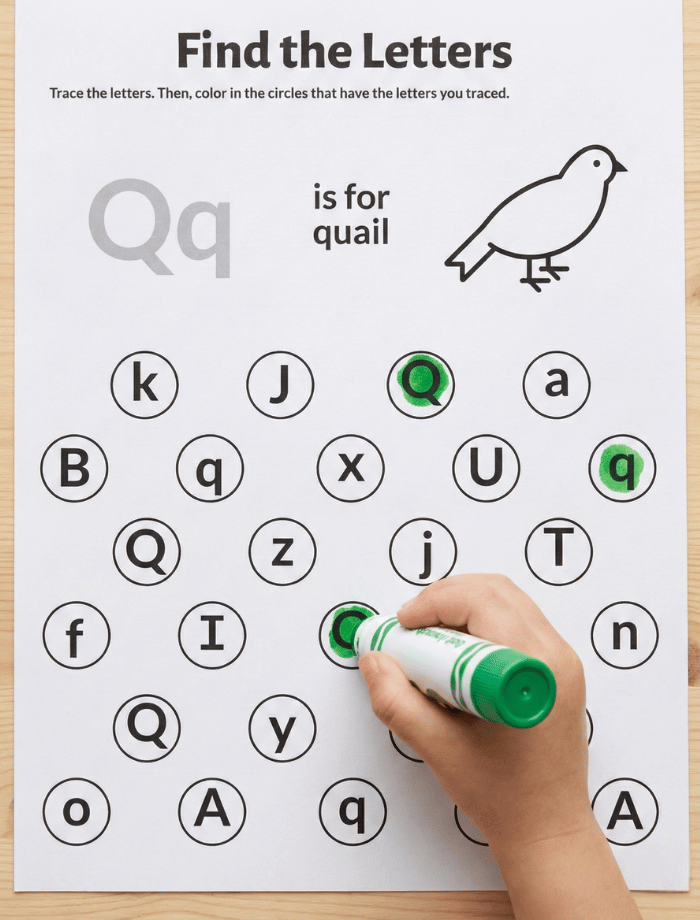
How to do it:
- Download and print our Letter Q Hunt worksheet (or create your own by scattering uppercase and lowercase Q's among other letters on a page).
- Give your child dot markers in their favorite colors.
- Ask them to find all the letter Q's (both uppercase and lowercase) and place a dot on each one.
- For younger children, point to a letter Q and say, "This is the letter Q. Can you find more letters that look like this one?"
- Count how many letter Q's they found when finished!
Extension: Use two different colors—one for uppercase Q and one for lowercase q. This helps reinforce the difference between the two forms.
Learning benefit: Strengthens letter recognition, visual discrimination, and hand-eye coordination.
Activity 3: Letter Q Search & Match Game
⏱️ Prep Time: 5 minutes
🎨 Materials: Post-it notes, marker, two pieces of cardstock, tape
My kids are absolutely obsessed with this activity! Even though we play it for every letter, it never gets old. The element of hide-and-seek combined with learning makes this one of those activities where they'll ask to play it again and again. It's perfect for burning energy while learning.
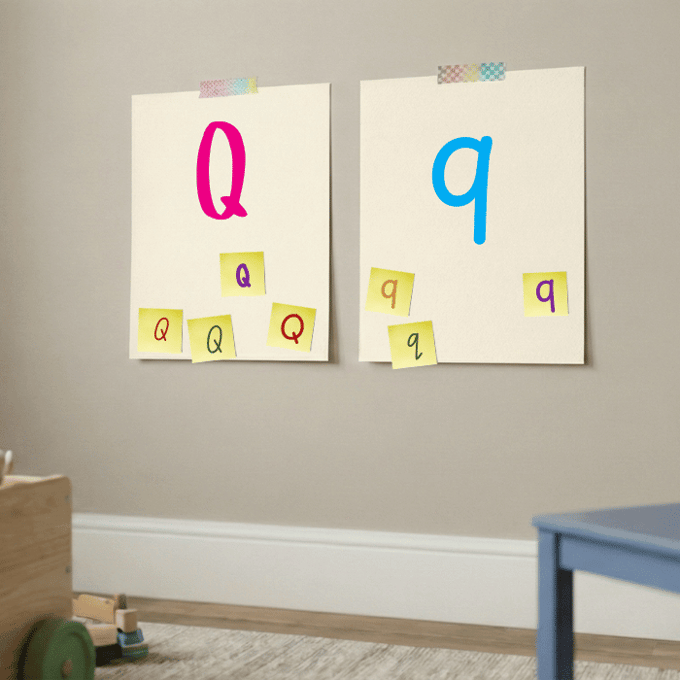
How to do it:
- Draw a large uppercase Q on one piece of cardstock and a lowercase q on another.
- Tape both papers to the wall at your child's eye level.
- Write uppercase Q's and lowercase q's on 10-15 Post-it notes (mix them up).
- Hide the post-its around your living room, playroom, or classroom—stick them on furniture, under pillows, behind toys.
- Have your child search for the post-its. When they find one, they bring it to you.
- Ask them: "Is this an uppercase Q or a lowercase q?" Then help them stick it on the matching letter on the wall.
- Once all post-its are found, hide them again and play another round!
Learning benefit: Teaches uppercase and lowercase letter recognition while incorporating movement and problem-solving.
Activity 4: Playdough Letter Formation
⏱️ Prep Time: 2 minutes
🎨 Materials: Playdough (any color), letter Q card or printable
Whenever I pull out the playdough, my kids play with it for at least half an hour. Since playdough is so engaging, it makes for a wonderful learning activity! This simple exercise helps children understand the shape and strokes of the letter Q through hands-on manipulation.
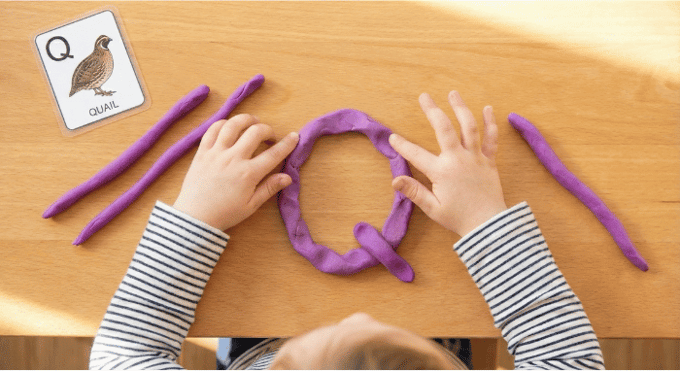
How to do it:
- Roll out the playdough into long "snakes" (about pencil thickness).
- Show your child a letter Q card or a printable as a model.
- Guide them in forming the letter Q: make one circle, then add a small tail line at the bottom right.
- For younger children, draw a large letter Q on paper and have them place the playdough snakes on top of the lines.
- Let them make the letter Q several times, using different colors.
- Say the letter name and sound each time they complete it: "This is the letter Q. It says /kw/."
Extension: Once they've mastered uppercase Q, try lowercase q. Or challenge them to make the letter Q without looking at the model.
Learning benefit: Develops fine motor skills, muscle memory for letter formation, and tactile learning.
Activity 5: Quarter Sensory Bin
⏱️ Prep Time: 10 minutes
🎨 Materials: Large bin, rice or dried beans, quarters (15-20 coins, cleaned)
Q is for quarters! Sensory bins are amazing for preschoolers because they engage multiple senses while learning. This themed sensory bin reinforces the letter Q sound while providing calming, focused play. You can use this sensory bin all week long as you work on the letter Q.
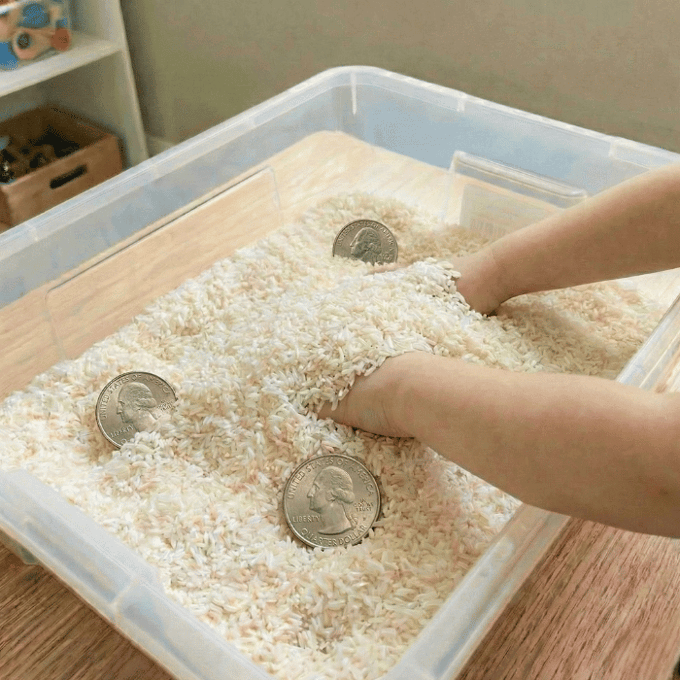
How to do it:
- Fill a large bin (a plastic storage container works great) with 4-6 cups of rice or dried beans.
- Hide 15-20 quarters (cleaned).
- Add measuring cups, scoops, and small containers for pouring and transferring.
- Let your child dig, pour, scoop, and discover the coins.
- As they play, emphasize: "Q is for quarter! Can you say /kw/, /kw/, quarter?"
Extension: Count quarters by ones, discuss coin value, or practice stacking quarters into towers.
Learning benefit: Reinforces beginning letter sounds, provides sensory input, builds fine motor skills, and introduces early money concepts and counting.
Activity 6: Salt Tray Letter Tracing
⏱️ Prep Time: 3 minutes
🎨 Materials: Shallow tray or baking sheet, salt or sand, letter Q card
This multi-sensory approach to letter writing helps children feel the letter's shape with their finger. The salt provides tactile feedback that helps reinforce the muscle memory needed for handwriting. Plus, mistakes are easy to fix - shake the tray and start over!
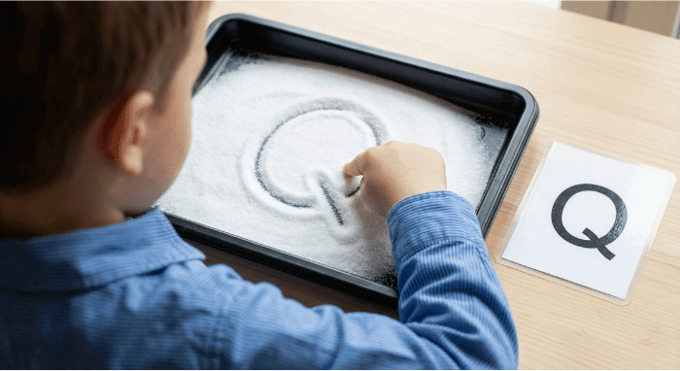
How to do it:
- Pour a thin layer of salt (or colored sand) into a shallow tray or rimmed baking sheet.
- Show your child how to form the letter Q in the salt using their pointer finger.
- Say the letter formation steps as they trace: "Start at the top and make a circle all the way around. Now add a little tail at the bottom right."
- Let them trace the letter Q multiple times.
- For younger children, you can trace it first, then have them trace over your lines.
- Shake the tray gently to erase and start fresh.
Extension: Use a paintbrush instead of a finger, write in shaving cream on a table, or trace letters in sand at the beach or sandbox.
Learning benefit: Pre-writing skills, letter formation practice, and sensory learning.
Activity 7: Beginning Sound Sorting
⏱️ Prep Time: 5 minutes
🎨 Materials: Picture cards or small objects, two baskets or containers, letter Q card
This phonics activity helps your child connect the letter Q with its sound. It's a simple but powerful exercise that builds phonemic awareness - one of the strongest predictors of reading success. You can use this same setup for every letter!
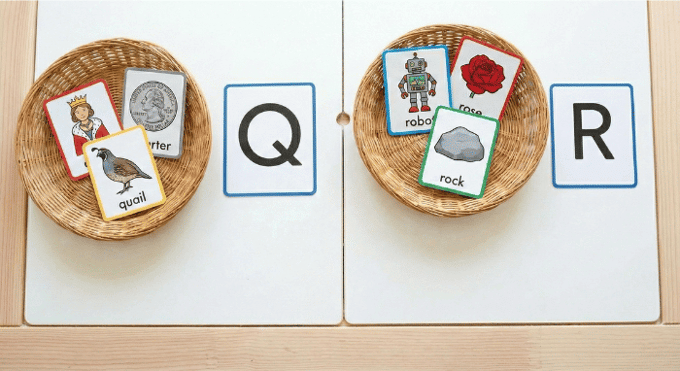
How to do it:
- Gather 5-7 picture cards or small objects that start with Q (queen, quilt, quarter, quail) and 5-7 that start with R (rabbit, rain, ring, robot, rose, rock).
- Label two baskets or containers - one with the letter Q, one with R.
- Show your child each picture or object one at a time.
- Say the word slowly, emphasizing the beginning sound: "Q-q-queen. Do you hear /kw/ at the beginning? Queen starts with the letter Q!"
- Ask your child to put it in the correct basket.
- If they're unsure, repeat the sound together and guide them to the right basket.
Extension: Once they master sorting two letters, add a third basket with a different letter.
Learning benefit: Develops phonemic awareness, auditory discrimination, and letter-sound correspondence.
Activity 8: Sticker Letter Fill
⏱️ Prep Time: 5 minutes
🎨 Materials: Stickers (any kind), large letter Q outline, glue (optional)
Kids absolutely love peeling and sticking! This simple activity lets them fill the letter Q with colorful stickers while building letter recognition. It's perfect for younger preschoolers who might not be ready for tracing or writing but can still learn the letter's shape.
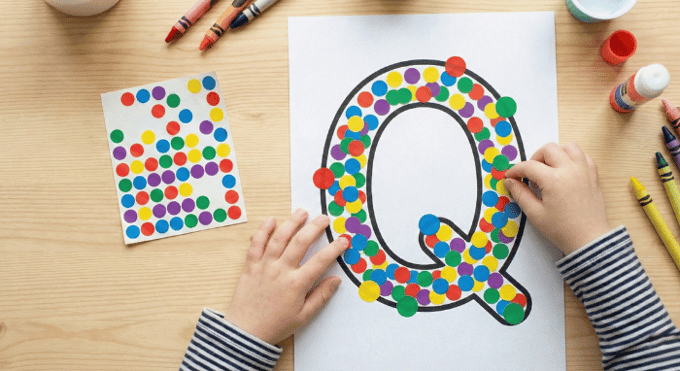
How to do it:
- Print or draw a large bubble letter Q on cardstock.
- Give your child a sheet of stickers—dot stickers, star stickers, or any stickers you have on hand work great.
- Show them how to peel the stickers and place them inside the lines of the letter Q.
- Encourage them to fill the entire letter, placing stickers close together.
- As they work, keep saying: "You're decorating the letter Q! This is the letter Q"
- Count the stickers when finished: "You used 49 stickers to make your letter Q!"
Variations: Use pom-poms with glue dots, beans with glue, or torn tissue paper squares instead of stickers.
Learning benefit: Fine motor development (peeling stickers), letter shape recognition, and hand-eye coordination.
Activity 9: Letter Q Floor Hop
⏱️ Prep Time: 3 minutes
🎨 Materials: Painter's tape (or chalk if outdoors), open floor space
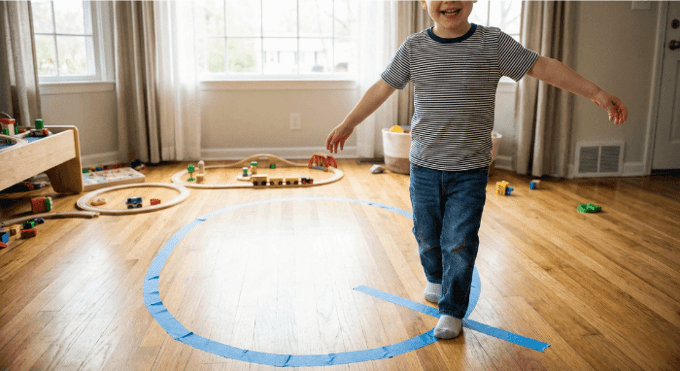
This gross motor activity is perfect for active learners who need to move while they learn! Combining physical movement with letter recognition helps some children learn better. Plus, it's a great way to burn off energy on rainy days.
How to do it:
- Use painter's tape to create a large letter Q on your floor (each line should be about 3-4 feet long).
- Show your child the letter and say, "This is the letter Q!"
- Have them hop, jump, walk, or tiptoe along the lines of the letter Q.
- Call out directions: "Start at the top and hop all the way around the circle! Now hop on the little tail at the bottom right!"
- If you have multiple children, make it a game: "Who can walk the letter Q without stepping off the tape?"
Extension: Make several letters on the floor. Call out a letter and have them run to that letter and trace it with their feet.
Learning benefit: Gross motor skills, spatial awareness, letter recognition, and kinesthetic learning.
Activity 10: Letter Q Snack Formation
⏱️ Prep Time: 5 minutes
🎨 Materials: Crackers, cheese slices, apple slices, or pretzel sticks
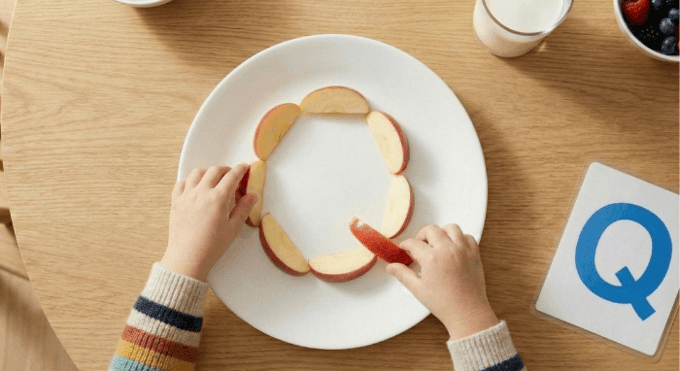
Turn snack time into letter learning! This edible activity combines fine motor practice with letter recognition - and your child gets to eat their creation when they're done. It's a perfect way to end your letter Q activities on a delicious note.
How to do it:
- Choose snack items that can be arranged into shapes (graham crackers, cheese crackers, cheese slices cut into strips, apple slices, pretzel sticks, or string cheese pulled into strips).
- Show your child the letter Q on a card or write it on paper as a reference.
- Help them arrange their snack items on a plate to form the letter Q: curved pieces (apple slices, orange slices, or cucumber rounds) arranged in a circle shape, with one small piece (pretzel stick, carrot stick, or raisin) at the bottom right for the tail.
- Talk about the letter shape as they build: "Q is a circle like the letter O, but it has a little tail sticking out at the bottom right."
- Take a photo of their edible letter before they eat it!
- While eating, practice the letter sound: "Q says /kw/ like in queen!"
Extension: Try different food combinations - use banana slices for the circle with a small pretzel stick for the tail, or arrange grape halves in a circle with a blueberry for the tail. For younger children, draw the letter Q outline on the plate with a dry-erase marker as a guide.
Learning benefit: Letter shape recognition, fine motor skills, following a model/pattern, spatial awareness, and letter-sound connection.
Tips for Teaching Letter Q Successfully
Start with Uppercase First
Uppercase letters are visually simpler and easier for young children to recognize and write. Introduce uppercase Q first, then add lowercase a once they're confident with the capital letter.
Connect the Letter to Your Child's World
Point out the letter Q everywhere—on food packages, street signs, toy boxes, and in books. Say things like, "Look! 'Queen' starts with the letter Q!" This real-world connection helps cement letter recognition.
Do Multiple Activities in One Week
Don't try to do all 10 activities in one day. Spread them across a week, doing 1-2 activities each day. This repetition in different formats helps children truly learn and remember the letter.
Focus on the Sound, Not Just the Name
Always teach both the letter name ("This is the letter Q") and the letter sound ("Q says /kw/ like in quack - the sound a duck makes"). Phonics skills are crucial for reading success.
Make It Playful, Not Pressured
If your child isn't interested one day, that's okay! Put the activity away and try again another time. Learning should feel like play, not work.
Adjust for Your Child's Age
For 3-year-olds, focus on letter recognition and simple crafts. For 4-5 year-olds, add letter writing practice and beginning sound activities. Every child develops at their own pace.
Letter Q Show and Tell Ideas for Preschool
Let's be honest - letter Q is the one that makes parents sweat. It's the letter where you stare at the ceiling at 10 PM trying to think of anything besides "queen" and "quilt." The good news? There are more Q options than you think. The even better news? Your child only needs one.
Realistic Letter Q Items You Can Actually Find
These aren't obscure words from a dictionary. These are real items you can put in a backpack:
- Quarter – a single coin from a jar. Your child can show both sides, name the state if it's a state quarter, and talk about what they'd buy with it. "/kw/, /kw/, quarter!"
- Quilt or blanket – a small quilt, a quilted placemat, or even a quilted jacket. If you have a family quilt with a story behind it, that's even better - your child can share who made it.
- Queen costume piece – a tiara, a crown, or a dress-up gown. Your child can declare themselves queen for the day and present in character.
- Q-tip – a clean, unused one. Simple and silly, but it starts with Q and kids can demonstrate (gently) what it's used for. Bring a few extras so your child can use them for a dotting art activity if the teacher allows it.
- Question mark – draw a big, colorful question mark on paper. Your child can hold it up and ask the class a question: "Does anyone know what letter this starts with?" It's meta, it's clever, and it works.
Letter Q Animals
Q animals are rare, but they exist - and the unusual ones actually make for better presentations because no one else in the class will have seen them:
- Quail (show a picture from a book or print one out)
- Queen bee (any toy bee can become a queen bee with a tiny paper crown glued on)
- Quokka (look up a photo - they're called the happiest animal on Earth and preschoolers will love the smiling face)
- Quetzal (a brightly colored bird from Central America - a printed picture works great)
Letter Q Foods
This is the thinnest food category in the alphabet, but a few options exist if you get creative:
- Quesadilla (wrap a small one in foil - easy, warm, and delicious)
- Quinoa (dry in a small bag to shake and look at, or cooked in a container)
- Quaker oats packet (the brand name starts with Q - it counts)
- Quiche (a small slice in a container if you're ambitious)
Creative Letter Q Show and Tell Ideas
Q is the letter where creativity matters most. These ideas turn a tough week into a memorable one:
- Quiz game – your child prepares three simple questions for the class: "What color is the sky? How many legs does a dog have? What letter are we learning this week?" They become the quiz master, "quiz" starts with Q, and every kid in the room will raise their hand to answer. This turns show and tell into an interactive game.
- "Quiet" jar – fill a clear bottle or jar with glitter, water, and a drop of glue (a DIY calm-down jar). Your child shakes it, the class goes silent watching the glitter settle, and they explain that "quiet" starts with Q. The irony of a noisy shake leading to a quiet moment is not lost on preschoolers.
- Quack puppet – make a simple duck hand puppet from a paper bag or a sock. Your child can make it quack for the class. "Quack" starts with Q and puppet shows are always a hit. Works especially well combined with the letter D's duck if you still have it.
- Quick drawing challenge – your child draws something as fast as they can in front of the class (10 seconds on a timer) and the class guesses what it is. "Quick" starts with Q and the time pressure makes it exciting. Even a bad drawing is funny, which takes the pressure off.
- Queen or king card – pull a queen from a deck of playing cards. Your child can show it to the class, describe the picture, and explain that "queen" starts with Q. They can also try to spot the letter Q on the card.
- Question box – decorate a small box with question marks the night before. Inside, put three slips of paper with questions your child wrote (or dictated to you): "What's your favorite animal? What did you eat for breakfast? Do you like rain?" Your child pulls out questions and asks classmates to answer. Interactive, educational, and entirely Q-themed.
Surviving (and Enjoying) Letter Q Show and Tell
Q is tough. Here's how to handle it without losing sleep:
- Q always travels with U. This is a fun rule to share with your child: in almost every English word, Q is followed by U. They're best friends! "Queen, quilt, quarter, quiet - see the U right after the Q?" Preschoolers love the idea of letters being friends, and this is one of the most reliable patterns in English spelling. It gives them something interesting to say during their presentation that will genuinely impress the teacher.
- Don't panic about finding the "right" item. Q is the letter where parents put the most pressure on themselves. But here's perspective: the teacher has watched 20 kids bring quarters and Q-tips for letter Q week. There is no wrong answer. A quarter in a bag with a smile on your child's face is a perfectly successful show and tell.
- Lean into the interactive options. Q's best items aren't objects - they're activities. A quiz, a question box, a quick drawing challenge. If you can't find a great Q item in your house, shift your thinking from "what can they hold?" to "what can they do?" The best Q presentations are the ones where the whole class participates.
- Practice the /kw/ sound as a team. The Q sound is actually two sounds blended together: /k/ and /w/. Have your child say "kuh-wuh" slowly, then speed it up: "kwuh... kween! kwuh... kwiet!" Making it feel like a tongue-twister challenge (rather than a drill) keeps the energy light. If they can nail the /kw/ blend, they'll feel like they cracked a code.
Ready for more letter Q activities? Scroll up to explore all 10 of our letter Q ideas - crafts, sensory play, and phonics games that prove Q isn't as scary as it looks!
Keep the Alphabet Fun Going!
Up Next: Ready to move on? Try our Letter R Activities for Preschoolers for even more hands-on learning fun!
Complete Collection: See all our letter activities in our Letter Recognition Activities Hub.
