A homeschool curriculum for autism, ADHD and speech delay that moves at your child's pace, whatever that pace is
Kindy has no separate mode for autism, ADHD or speech delay, and we want to say that plainly. What it has is a way of working that many children with different needs do well with: it starts from what your child can do, not their age, moves at the pace your child shows you, and tells you exactly what to do and what to say. Here is how that works, and how to judge whether it fits your child.
Free for 7 days, then $9.99 a month. It starts with a short check of what your child can already do. Cancel in one tap.
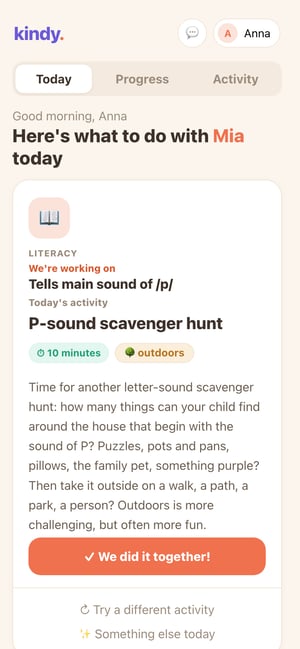
Your child's age is not on the page. Your child is.
Kindy never works from a birthday. A short check of what your child can already do places them on every skill, and the plan starts there. A four-year-old working at a two-year-old level in speech gets speech activities at that level, with no label attached and no steps skipped. A child who is ahead in letters and behind in feelings gets exactly that mix.
Two children with the same diagnosis can be in very different places. Two children without one can be in the same place. The plan follows the child.
If something takes two months instead of two weeks, the plan takes two months.
After each activity, you tap how it went: Nailed it, Almost, or Not yet. "Not yet" brings the skill back for more practice, as often as needed, often through a different activity. A skill only counts as mastered after three clear successes. New skills appear only once the ones they build on are solid, and mastered skills return every couple of weeks for review, so they stay.
Nothing else falls behind while one skill takes its time. The other areas keep moving at their own pace.
Why the way Kindy works suits many children with different needs
These are not special features. They are how every Kindy activity is built, and they line up with what the research on early support for autism, ADHD and speech delay keeps finding.
Built on talking together
Every activity tells you what to say as well as what to do. Much of the language work is the kind of modeling speech therapists teach parents: naming, describing, taking turns, stretching a sentence by one word.
Explicit, step-by-step instructions
One clear thing to do, in order, written so you can read it once and start. Many autistic children and children with ADHD do better with this than with open-ended play.
A steady feelings strand
Naming feelings, calm-down skills, turn-taking, saying goodbye. Practiced regularly, in small doses, instead of left to chance.
Inside your routines
Cleanup, the walk, the bath, the same book again. Skills taught inside real moments carry over better than skills taught at a table.
Follows your child's interest
Not into today's activity? Open the alternatives that teach the same skill and pick one that fits. Or move to another skill for now. The first one comes back later.
Short, repeated, daily
Most activities take about ten minutes, and the same skill comes back in different ways until it sticks. Small daily doses are what the parent-led research relies on.
Your own materials count
Log an exercise from your therapist or an idea of your own, tie it to the skill, and it credits that skill like a Kindy activity.
Pause any skill set
If a specialist wants to handle an area their own way, pause it. Its activities leave the rotation until you bring it back.
Kindy is not therapy, and it does not replace it.
It is playful daily practice at home, alongside the support your child already has. The research on early support is clear that the parent's daily practice is where much of the progress happens. That is the part Kindy carries: the plan, the order, the words, and the tracking, so your ten minutes on the floor count.
Two things Kindy does not give you, so you can plan for them: it has no visual schedules or first-then boards (many families make their own, and they work well next to Kindy), and it is not behavior-management coaching. For a preschooler with ADHD, that coaching for parents is the first-line support pediatricians recommend. Kindy fits beside it.
Activities for autistic toddlers and preschoolers
Three real Kindy activities, shown the way they appear in the app. Each one is taught inside a moment you already have. A child working at a younger level gets activities at that level.
Sort toys at cleanup
What to do: Turn cleanup into a sorting game: blocks go in one bin, stuffed animals in another. Same bins, same places, every time.
Why it fits: A skill taught inside a routine your child already knows, with a clear structure and the same steps each day.Sing and act out feelings
What to do: Sing "If You're Happy and You Know It," then change the feeling each verse: "If you're surprised and you know it, say Oh my!" Sleepy, angry, scared. Big faces, big motions, together.
Why it fits: Imitation, shared attention and a familiar song with predictable turns: the moves the research on early autism support keeps coming back to.Make an anger thermometer
What to do: Draw a tall thermometer together and mark it from calm at the bottom to boiling over at the top. Your child names and colors each level. Keep it on the fridge.
Why it fits: A visual support for feelings. Visual supports are one of the named evidence-based practices for autistic children from preschool on.Speech delay activities for toddlers and preschoolers
The strategies below are the ones parent-led speech programs teach: wait, follow your child's lead, comment more than you ask, and add one word. Kindy's language activities are built on them. If your child sees a speech therapist, these are easy to share, and the therapist's own exercises can be logged in Kindy too.
Fill-in-the-blank storytime
What to do: Read a book your child knows inside and out. At the familiar moments, stop and leave the word out. Wait. Let your child fill it in, with a word, a sound or a gesture.
Why it fits: The pause is the whole activity. Waiting instead of filling the silence is the first strategy speech therapists teach parents.Walk and talk together
What to do: On your next walk, talk about what your child looks at. Follow their eyes, name it, add one word, and leave room for them to answer.
Why it fits: Follow the lead, name, expand by one word: the modeling that parent-led language programs are built on.For a child with ADHD: short, moving, and done while it is still fun
Kindy's activities are short and hands-on, and many involve moving. You get one clear thing to do, and you can stop while it is still going well. Games that practice stopping and starting build the waiting muscle in a way children enjoy.
Play Simon Says
What to do: Play Simon Says, where a move only counts when "Simon says" so. Keep it fast, silly and short. Stop while it is still fun.
Why it fits: A stop-and-go game practices the waiting muscle, with movement built in. Short bursts with a laugh beat long sits.Who designed the curriculum

Vida Mercer
Lead curriculum designer · early childhood consultant since 2005
Vida is not a specialist in neurodivergence and holds no certification in it, and neither she nor Kindy claims clinical expertise. She has consulted with families of neurodivergent children, tutored and taught those children privately, and studied the techniques and adaptations that help them. That experience shaped how she designed the curriculum: explicit instruction, a great deal of talking together, a steady social-emotional strand, and a pace set by the specific child. In her words, that last part, along with the talking, is probably the greatest benefit to parents of children with special needs. Read more about us
Price
7 days free, then $9.99 a month.
Each additional child: $4.99 a month, with their own plan.
We email you before your card is charged. Cancel anytime in the app.
Questions parents ask us
Is there a free homeschool curriculum for autism?
Not one built around your child, as far as we know. There are good free activity ideas online, and many families start there. Kindy is not free, but your first week is, and the placement check costs nothing, so you can see the actual plan for your child before you decide.
Does Kindy replace therapy?
No. Kindy is not therapy and does not replace it. It is playful daily practice at home, alongside the support your child already has. If your child has a speech or occupational therapist, the activities are easy to share with them, and you can pause any skill set the therapist wants to handle differently.
Do I need to share a diagnosis?
No. Kindy never asks for one. The placement check only asks what your child can do today, and the plan is built from that. Two children with the same diagnosis can be in very different places, and two children without one can be in the same place. The plan follows the child, not the label.
What if my child learns more slowly?
Then the plan takes longer, and nothing else falls behind because of it. "Not yet" brings a skill back for more practice as often as needed. A skill only counts as mastered after three clear successes, and new skills appear only when the ones they build on are solid. Kindy paces the plan to your child's kindergarten start, but the pace inside it is set by your child.
Is Kindy for toddlers?
Kindy is built for the two years before kindergarten, roughly ages 3 to 5. It does not work from age, though. A four-year-old who is working at a two-year-old level in speech or play gets activities at that level, without a label and without skipping steps. If your child is younger than 3, the placement check will show you honestly whether the plan fits yet.
Does it work for ADHD?
Many families find that it does. Activities are short, hands-on and often involve moving, so they suit a child who cannot sit long. Every activity gives you one clear thing to do, and you can stop while it is still going well. For a preschooler with ADHD, the first-line support recommended by pediatricians is parent training in behavior management. Kindy is not that, but it fits well beside it.
Can I use my own therapy materials and activities?
Yes. Choose a skill, then use a Kindy activity, one of the alternatives for that skill, or log your own, including exercises from a therapist. A logged activity credits the same skill as a Kindy activity, so everything you do counts toward the same plan.
How does the free week work?
Start with the short check of what your child can already do, then begin your free week. You get the full curriculum for 7 days. We email you before your card is charged, and you can cancel anytime in the app.
More for your situation
The same curriculum, explained for where you are starting from.
Your child does not need to fit a curriculum.
This one fits your child. It starts from what they can do today, moves when they are ready, and gives you the words for every step. See the actual plan for your child before you decide anything.
Free for 7 days, then $9.99 a month. It starts with a short check of what your child can already do.