A play-based preschool homeschool curriculum, with a purpose under every game
Hands-on, screen-free for your child, and almost never at a desk. 218 skills across 7 areas, each one taught through a game, a hunt, a song, a book or a kitchen job, with the skill named. You see what each activity is for, and you see it get mastered.
Free for 7 days, then $9.99 a month. It starts with a short check of what your child can already do. Cancel in one tap.
Play is enough, when there is a skill underneath it.
Researchers who study how young children learn compared three things: free play, direct instruction, and guided play, where a grown-up sets a learning goal and shapes the setting while the child keeps control. Guided play taught early literacy and math as well as or better than direct instruction, and more than free play alone. Children learned more words and more spatial skills when an adult played alongside with a purpose.
That is what a Kindy activity is. Not free play, and not a lesson. A game your child wants to play, with one skill underneath it that you can see, and an activity written so the game becomes learning. The play looks like play. The curriculum keeps score.
Inside one Kindy activity
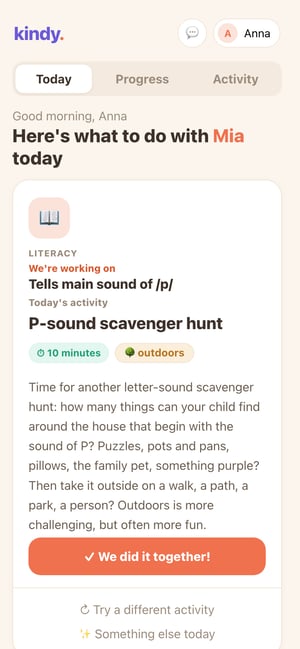
Here is a real activity, exactly as it appears in the app, opened up so you can see what is built into it.
Roll a die and have your child count the dots. Then they place that many small toys or objects into an empty ice cube tray, one per slot, dump it out, and roll again. (Using tweezers to place the pieces makes it more fun and doubles as fine-motor practice.) 4
- The skill underneath. Every activity is tied to one of the 218 skills. This one is "understands one-to-one correspondence": one number for one thing, the idea all of counting rests on. You always know what the game is for.
- A game, not a lesson. Dice, an ice-cube tray, a handful of small toys. Your child rolls, counts, places, dumps, rolls again. They will ask to play it tomorrow.
- Short, and honest about it. About ten minutes, hands-on. The chips tell you before you start whether it is a book, a game, a walk or a kitchen job.
- What to do, and a bonus you did not have to plan. The words are written so you can read them once and play. The tweezers line turns a counting game into fine-motor practice as well, without a second activity.
- One tap when you are done. Nailed it, Almost, or Not yet. That tap decides what comes next. Three Nailed its and the skill is mastered; it steps aside and returns for quick reviews so it sticks.
- Yours to steer. Not the right game today? Try a different activity for the same skill. Not the right skill? Something else today, and this one comes back when your child is more ready for it.
Play across the whole map
Every one of the 520 activities is one of these kinds of play. Real counts from the curriculum, so you can see what your days will be made of.
Hands-on
214 activitiesBlocks, tweezers, snack pieces, clothespins, the toys on the floor.
Talking together
104 activitiesQuestions on a walk, retelling a story, a feelings word at breakfast.
With a book
51 activitiesFill in the missing word, hunt for a letter, wonder what happens next.
Games
43 activitiesHide-and-seek for letters, Simon Says, dice, board games.
Songs
20 activitiesThe ABC song on the chart, feelings verses, counting rhymes.
Outdoors
13 activitiesNumber hunts, hopscotch to 20, find 20 mailboxes.
Printable pages
70 activitiesFor the child who likes them. Always swappable for a hands-on alternative.
450 of the 520 need no paper at all. And play covers every area, not only the fun ones:
Letters and sounds
- Letter B hide-and-seek
- Spot words that start with S
- Turn S into a snake
Numbers
- Roll dice and count the dots
- Hopscotch count to 20
- Kitchen counting
Talking and listening
- Walk and talk together
- Fill-in-the-blank storytime
- Play Telephone or Simon Says
Thinking
- Sort toys at cleanup
- Break out a logic game
- Story memory challenge
Feelings and friends
- Sing and act out feelings
- Make an anger thermometer
- Self-control games and pretend play
Little hands
- Rip-and-stick collage
- Tweezer transfer
- Clothespin clip-on
Focus
- Finish a 20-piece puzzle
- Red Light Green Light
- Try a calm-down practice
Sitting still is not required. It is not the point either.
Most Kindy activities happen standing, walking, hunting, building, cooking or singing. Letters are found on cereal boxes and street signs. Counting happens on a hopscotch course and in the grocery cart. Feelings are sung, acted out and drawn. Focus is practiced with Red Light Green Light, not with a chair.
When today's activity does not land, you are not stuck with it. Open the alternatives for the same skill and pick one that fits your child's mood, or move to a different skill and let this one come back another day. The map stays the same. The way through it follows your child.
The materials are already in your house.
Paper, crayons, blocks, snacks, books, a die, clothespins, the toys on the floor. Each activity tells you what to grab, and there is nothing to set up the night before. If you love making sensory bins and trays, keep making them: log them in Kindy, tie them to the skill they build, and they count toward the same plan.
Some activities come with an optional printable, 70 of the 520, for the child who enjoys a page. Every one of them has hands-on alternatives for the same skill, one tap away.
A week of play
Five real Kindy activities from four areas. Yours will differ, because every one is picked for your child.
Find 20 of something
On a walk, pick a target and count until you find 20 of them: mailboxes, garbage cans, dogs, whatever your child chooses. Have them keep the running count out loud.
You need: a walkLetter B hide-and-seek
Play letter hide-and-seek: take turns finding the letter B on a cereal box, grocery store signs, or a page of a favorite book.
You need: a cereal box, a book, or some signsRead everyday signs together
While you are out and about, read signs to your child and talk about what each one means. Follow a recipe together, or read the instructions while you assemble something. It all builds the big idea: print carries meaning.
You need: wherever you are going anywayDraw your feelings
Walk back through the feelings from the song, happy, surprised, excited, sad, scared, sleepy, angry, and have your child draw something that made them feel each one. Talk as they draw.
You need: paper and crayonsBreak out a logic game
Play a simple board or card game that gives early logic a workout: taking turns, planning moves, thinking ahead. Go Fish, Sequence for Kids, Checkers, Dinosaur Escape.
You need: a simple board or card gameThe play looks like play. The map underneath keeps score.
After each activity, you tap how it went: Nailed it, Almost, or Not yet. "Not yet" brings the skill back another day, often through a different game. Three "Nailed it"s and it is mastered. It leaves the daily plan and returns now and then for a quick review, so it sticks.
You see each of the 7 areas fill in, skill by skill, and you see the plan pace itself to your child's first day of kindergarten. That is the difference between play and play with a purpose: not what the afternoon looks like, but that you can see where it is going.
Who designed the curriculum

Vida Mercer
Lead curriculum designer · early childhood consultant since 2005
Kindy's curriculum is written and sequenced by early childhood specialists, led by Vida Mercer, working from research on how three, four and five year olds develop. Every skill is mapped to the CDC's developmental milestones and placed in the order children really learn it, so nothing important is skipped and nothing is asked before your child is ready. Each skill comes with several hands-on activities, and the same skill comes back in different ways until it sticks. That is how children this age learn best: one good thing, many times, with you. Read more about us
Price
7 days free, then $9.99 a month.
Each additional child: $4.99 a month, with their own plan.
We email you before your card is charged. Cancel anytime in the app.
Questions play-based homeschool moms ask us
Is play-based learning enough to get my child ready for kindergarten?
Yes, when there is a skill under the play. Research comparing free play, guided play and direct instruction finds that guided play, where the adult sets a goal and the child keeps control, teaches early literacy and math as well as or better than direct instruction, and more than free play alone. Every Kindy activity is built that way: a game, a hunt, a book or a kitchen job, with one named skill underneath.
My child will not sit still. Will this work?
Yes. Most Kindy activities happen standing, walking, hunting, building or singing. Sitting still is not required, and it is not the point. If today's activity does not land, swap it for another that teaches the same skill, or come back to it another day.
Are there worksheets?
Some. 70 of the 520 activities come as a printable page, for the child who likes them, and 450 need no paper at all. A printable is never required: every skill has hands-on alternatives, and you can swap in one tap.
How much prep and how many materials?
Almost none. Activities use what is in the house: paper, crayons, blocks, snacks, books, a die, the toys on the floor. The activity tells you what to grab. There are no sensory bins to build unless you enjoy building them, and if you do, log them and they count.
My child is a kinesthetic learner. Is Kindy right for that?
If your child learns by doing and moving, Kindy fits. Most activities are hands-on, and many involve moving around the house or outdoors. We do not sort children by learning style, because the research does not support teaching that way. We build activities the way young children learn: by touching, moving, talking and doing, with you.
How much should we do each day?
Kindy opens with one activity and offers more, up to five a day across different areas. Most take about ten minutes. On a big-energy morning, do several. On a busy day, one still counts.
My child only wants to play one thing right now.
Then start there. Choose the skill, or take the one Kindy suggests, and pick the activity that fits your child today from the alternatives for that skill. Or log the play they are already doing, tie it to the skill it builds, and it counts.
How do I know it is working, if it all looks like play?
After each activity you tap how it went: Nailed it, Almost, or Not yet. Three Nailed its and a skill is mastered. It leaves the daily plan and comes back for quick reviews. You see every area fill in, skill by skill, all the way to kindergarten. The play looks like play. The map underneath keeps score.
How does the free week work?
Start with the short check of what your child can already do, then begin your free week. You get the full curriculum for 7 days. We email you before your card is charged, and you can cancel anytime in the app.
More for your situation
The same curriculum, explained for where you are starting from.
Every game your child asks to play again is building something.
Kindy tells you what, hands you the next one, and keeps the map. See where your child is today, for free, and what the first game would be.
Free for 7 days, then $9.99 a month. It starts with a short check of what your child can already do.